Showing posts with label Gardening. Show all posts

Thursday, July 7, 2011

Achuete

The seeds of Bixa orellana is commonly used as a food coloring in Asian cuisine.  It's more popularly known as Achuete (Atsuete) or Annato seeds.

Marketmanila, my favorite food blog, has entries on Atchuete in the following links:

... As an ingredient in Pancit Luglug

... and in Kare-kare (Oxtail Stew in Peanut Sauce) as well.

However, people were surprised to see it in some of the flower arrangements my mom brings to the shop.  And why not - the seedpods are a vibrant color of red. It adds an interesting texture and a splash of color.


It goes well with orchid blooms and variegated foliage.


... and as an added benefit, long after the orchids have dried up, you can still put the dried seeds of the Achuete to good use, in Annato Oil.  Apparently it's commonly used in Carribean cuisine.  Recipe here:

"Achiote Oil"

And where to use it?

Deeny blogs about an interesting recipe for Chicken and Yellow Rice.  The picture on her page is positively mouthwatering.

Sunday, June 19, 2011

Update on Basil Cuttings

I haven't done much gardening lately, on account of a little health snag.  Most of my green work happened inside the house.  These are the cuttings that I left out to root 5 days ago.

Bringing Fresh Herbs in the Kitchen

Some of the cuttings have good root development already.  These are ready to be potted up soon.  I don't let it stay too long in water - it's a sterile medium with no nutrients whatsoever, and eventually, the cuttings lose a bit of their vigor of kept too long in water.


I have observed that basil grown from cuttings don't grow up as robust as seed-grown plants.  It's still a good way to propagate a particular variety, though  - and I can always harvest the dried seeds when these cuttings mature and eventually produce flowers.

Basil is something I must have perennially - and I'm thankful that we are in an area where spring is eternal.  Ok, a bit of an exaggeration - but we can grow these things year-round, even in scorching summer - and that's good enough for me.

Wednesday, June 15, 2011

An "Indoor" Pond

Well, technically, not "indoors".  It is separated from my folks' room by a glass sliding door.  We were wondering what to do with a small space that is within the perimeter of the room when we were doing the renovation.  The architect suggested that it be turned into a Zen garden.

Wonderful idea!  We're suckers for anything green and plant-like.  We promptly turned the project over to another architect, this time, a specialist in Landscape Design.

The landscape architect is much in-demand for projects involving resorts and such.  I'm so glad he took on this project, which is rather small by his standards - more of a micro Zen garden.  He suggested putting in a pond with a waterfall.  Complete with man-made boulders, and a mural of a mountain in the background.

And so it was.

Close-up of a Fern that grew wild, in the fern slabs that were attached to the wall.

Wider shot:


Part of the mural that the architect himself painted on the wall, depicting a forest-covered mountain.  The "root" cords are made of epoxy, molded by hand, and affixed to the wall.  The mural is doing very well, even if it is exposed to the elements.  This photo was taken when the painting was about 10 years old.  


For the pond greenery, we were limited by the low-light conditions available to the area - so I planted Cryptocorynes and Anubias.  Both plants thrive well in low light.

A tangle of Cryptocorynes - these have adjusted well and are now quite lush.


Once you created a hospitable and welcome environment, it's inevitable that others will find it pleasing as well.  Here, two kinds of ferns took root, brought along by spores carried from the winds.  Welcome to my garden, ferns!

Adiantum capillus-veneris


And, well, Fernus Ferni.   Ok, so this is still up for ID.  Patrick?  Help?

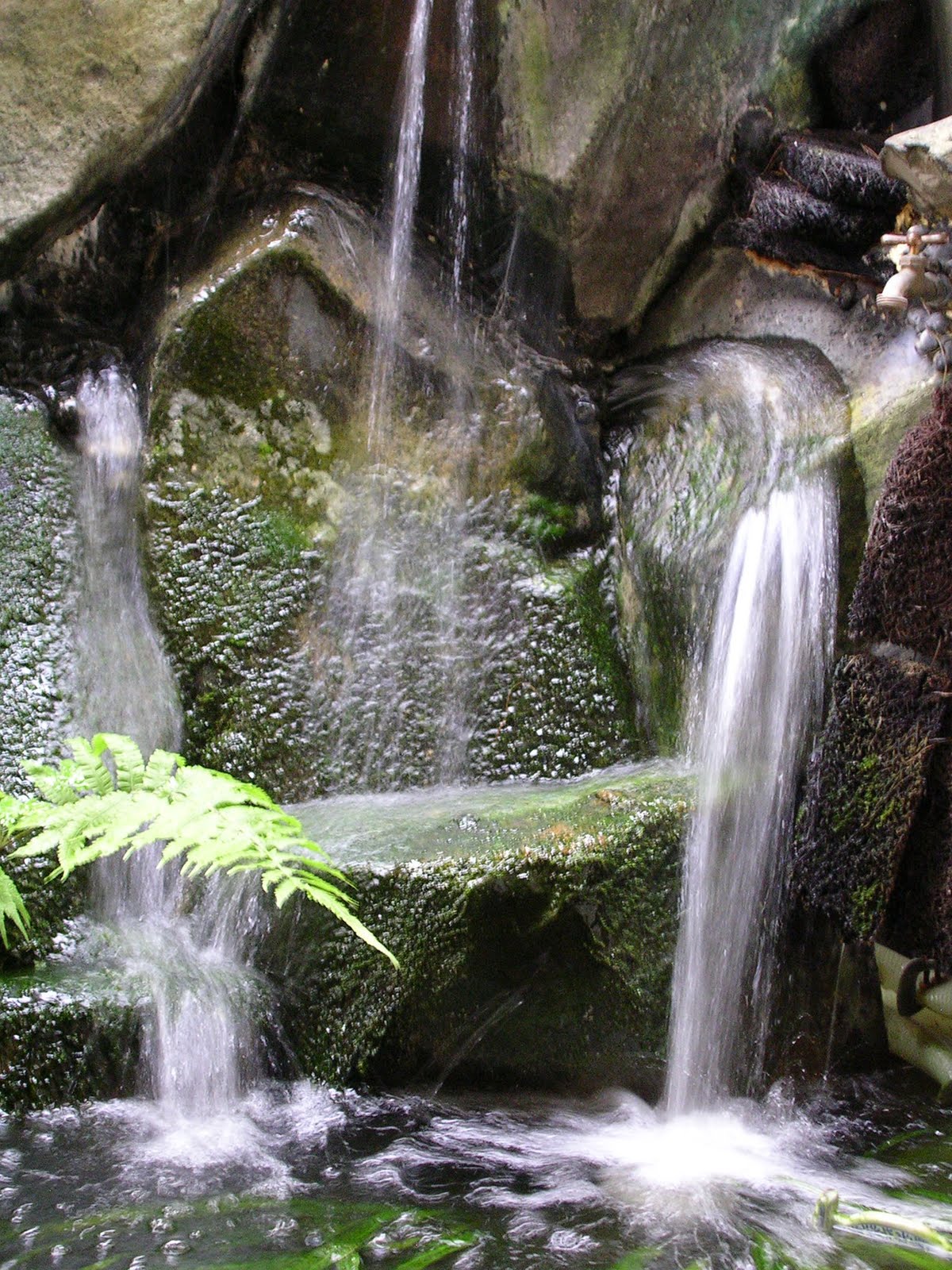
It's amazing that the design was able to incorporate a pond AND a waterfall, considering the space limitations.  The pump is a strong one.  Quite a torrent of water in this particular waterfall.


We have three functioning "waterfalls".  It was an artform - calibrating the amount of water that goes into each hose, so that there's a balance of flow in all three outlets.

The effect is quite natural, specially when the patina of moss covered the boulders.


There is a plan, afoot, to turn this pocket garden into a closet, since we were not able to put in enough closet space for the house.  I hope it doesn't happen, though.

Pockets of serenity are important in our lives.  It's a wonderful thing, to turn on the waterfall and listen to the sound it makes.  It's quite amusing to see the fish scrambling about, trying to get your attention, and begging for food.  It's amazing, how in their tiny communal brain, they associated human beings with providers of sustenance - and they do beg for food, much like a puppy.

I like the way this pond has matured.  Algae and moss has crept in, giving it a more natural look.  This in turn, provided a haven where ferns can thrive.

Life unfolds beyond the sliding door.

One merely has to step outside in order to observe and participate.

Tuesday, June 14, 2011

A Clean Way to Grow Table-Top Plants

I had plenty of downtime recently - and it was good time to catch up on gardening backlog.  Problem was that I couldn't stay outdoors for a long time (I was on antibiotics - specifically quinolones).  Hence, it was perfect time to tend to my window-sill greenery.

When the kitchen was renovated, the architect placed a wider ledge under the kitchen windows.  It was perfect for putting my sprigs of basil.  Gradually, the collection occupied a bigger space, to include various plants - even a fish bowl with a fighting fish.


(Click on Read More for continuation)

Sunday, June 12, 2011

My Pet Water Dragon

That's what I call my fighting fish (Scientific name:  Betta splendens).  I have two of them now - and I'm partial to blue.

I used to keep lots of them in tiny jars with plants - but it was a chore maintaining a bunch of unsightly algae-coated bowls with murky water.

Now, I only have two of those ugly things.

In a previous fit of impulsiveness common amongst serial hobbyist, I once ordered 8 (Eight!) mini-aquaria, each measuring about 10 inches cubed.  At present, most of them are empty souls.  Two of them, however, are in my room, and one is home to my happy fighting fish.  Quite an industrious one - he's always tending to his bubble nest.  Male betta's make nests with their own saliva, in preparation for rearing a brood of baby fighting fish.

My Betta's bubble nest.  He keeps really busy fixing up his nest.  Must find him a mate!
(Click on Read More for continuation)

Saturday, June 11, 2011

Rosemary

The scent of Rosemary is fresh, bracing, and quite invigorating.  Reminds me of Pine-scented air fresheners. It has an enticing aroma and it is positively mouth-watering, specially if it emanates from the oven, admixed with the heady vapors of lemon oils, roasted chicken, and garlic.  Ahhh!

Picture taken from Wikipedia, http://en.wikipedia.org/wiki/Rosemary


In spite of the fact that it ranks high in my list of favorite herbs, I do very little with it, actually.  I can only think of two dishes:  topped on focaccia, and baked inside the chicken recipe I just described.

Hence, I keep more pots of rosemary than I ever need.  Most of the sprigs end up as decor on gift boxes in lieu of ribbons - a bundle of fresh rosemary is a visual and olfactory delight, and the recipients can make use of it in their kitchen. Far more use than an ordinary non-biodegradable length of ribbon.

Growing Rosemary, however, is a bit of a challenge.  I used to have twenty pots of rosemary, all in a row -and one by one died on me.  I think they were severely over-watered.

Now, Rosemary does not like to keep her feet wet.  Far from being a dainty creature, it is actually a robust shrub, used to harsh conditions and sparse nutrients on Mediterranean soil.  Since I learned that rosemary prefers to be the alkaline side of the pH scale, I added crushed marble stones, easily available in construction supply stores, in the potting mix.  This also enhances drainage which is a boon for this dry-loving plants.  I'd rather see the plants a bit on the dry side, rather than water logged.

For the past 5 years, I seem to be doing well with rosemary.  I found a spot which they seem to prefer - bright but filtered sunlight, and full morning sun.  We keep the potting mix loose and well-draining - not a lot of organic material.  And we don't re-pot it too frequently.

I figured, after killing a lot of rosemary plants with too much kindness, that this plant actually thrives on a bit of neglect, and suffocates with too much care.  As with a lot of things in life. 

Snapshots from the Garden: Variegated Herbs / Fruits

Variety and Variegation in the garden.
Some herb and fruit trees are pretty enough to be ornamental plants.  Here are two of them:

Variegated Calamansi / Calamondin / Citrofortunella microcarpa


The leaves of the Variegated Calamansi are quite striking.  It brightens up the predominantly green foliage of the surrounding plants...


Variegated Cuban Oregano / Plectranthus amboinicus
     Apparently this herb is used in Carribean cuisine.  I haven't actually cooked with this - it seems a tad bit too strongly-scented.  I like having it around, though - the leaf pattern is interesting and there's a lot of texture, too.  The leaves are thick and succulent.  It's very easy to propagate, too.  Friends grow it at the base of a potted plant, to drive away aphids, in pest-prone plants such as Hibiscus.


Wednesday, June 8, 2011

Bringing Fresh Herbs in the Kitchen


Fresh herbs should be in the kitchen, for easy access.  Sometimes, plain inertia (laziness) gets in the way of going out in the rain (or blinding sunshine here in the tropics) to snip a few choice herbs from the garden.

I've discovered two ways to merge gardening and cooking duties:  I bring sprigs of fresh basil into the kitchen, trim down the lower leaves, and place them in jars with water.


Once I have harvested most of the leaves, I retain some on the sprig, and let the cuttings root out.  These cuttings can then be planted out in the garden, ensuring I have a continuous supply of fresh herbs.

(Click on Read More for continuation)